
Measuring
Measure accurately for a perfect fit
When taking measurments please make sure to measure to the nearest 1/8 of an inch.
Always record your measurements in the width by height format (W x H).
If you’re measuring more than one window frame, measure each frame individually. Never assume they’re the same size, even if they look alike.

Inside Mount
Inside mount is when the Shade is mounted inside of the frame.
Measure the exact width and height of your window frame opening. The shade will fit inside the window frame.
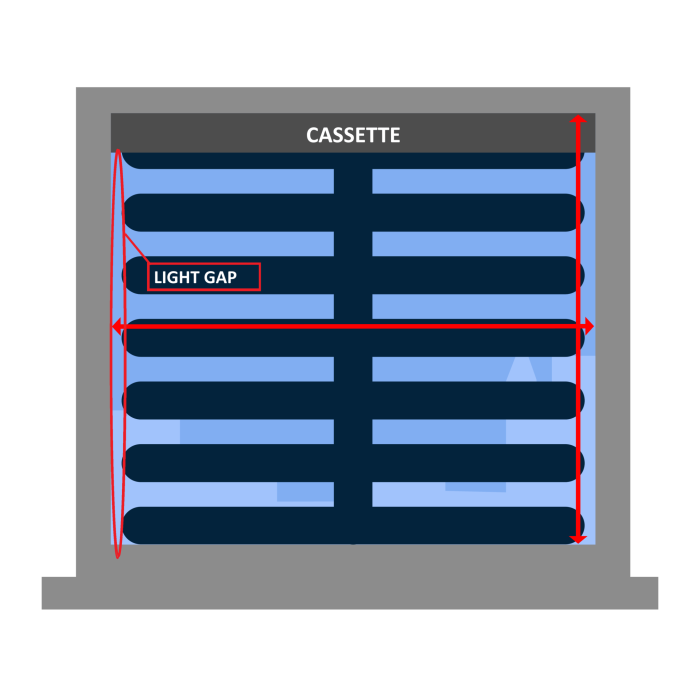
Cassette Depth:
Make sure to allow at least 2 1/4″ in Depth for the Cassette. All Cassette depth dimensions are listed at the bottom of every Product Page.
Always measure to the nearest 1/8”:
If a size falls on a 1/16” mark, round down to the nearest 1/8” mark for width and round up to the nearest 1/8” mark for height.
Important Note on Light Gap/Light Control:
All inside-mounted shades require a small clearance gap on each side to accommodate the operating mechanisms. This means a “halo” of light will be visible around the edges. If your goal is to minimize light gaps, we recommend choosing an Outside Mount Installation.
Width
Measure the width at the top, middle, and bottom
of the window opening. Always measure to the nearest 1/8". If a size falls on a 1/16” mark, round down to the nearest 1/8” mark for width.
Use the smallest width.
Height
Measure the height at the left, center, and right
of the window opening. Always measure to the nearest 1/8". If a size falls on a 1/16” mark, round up to the nearest 1/8” mark for height.
Use the tallest height.
Outside Mount
Outside mount is when the Shade is mounted over the frame. Your blind or shade will cover your frame.
The shade will be mounted on the wall, above the window and frame.

Cassette Height:
Make sure to account for the Cassette height. All Cassette height dimensions are listed at the bottom of each Product Page.
The following illustration shows the Cassette mounted to the moulding. If you choose to install the cassette on top of the moulding then you will need to measure for the entire moulding trim plus the height of the cassette. Also, take in to consideration if you are going to cover the window sill if you have one.
Always measure to the nearest 1/8”:
If a size falls on a 1/16” mark, round down to the nearest 1/8” mark for width
and round up to the nearest 1/8” mark for height.
Width & Height
Measure the area you want to cover. The shade will be mounted on the wall, above the window and frame. The Cassette height needs to be included. Make sure to check the Cassette height dimensions.
Common Questions
Answers to what customers ask most
Can I just measure my old blinds?
No. You should never measure your old blinds. Your old blinds may have warped over time, or the original factory deductions might be different from the new brand you are purchasing. Always measure the window opening itself for the most accurate fit.
What tool should I use to measure?
Always use a steel tape measure. Cloth or plastic measuring tapes (like those used for sewing) can stretch or sag, leading to inaccurate measurements. A laser measure is also an option but can sometimes be less precise for inside recesses if not calibrated correctly.
Do I need to measure every window, even if they look the same?
Yes. Windows that look identical often vary by small fractions of an inch due to house settling or framing variances. Measure every single window individually to ensure each blind fits perfectly.
Which number goes first, width or height?
The industry standard is always Width first, then Height (W x H). Getting this backward is the most common reason for misfitting blinds.
How do I measure the width for an inside mount?
Measure the width inside the frame at three points: the top, middle, and bottom.
- Rule: Use the narrowest of the three measurements. This ensures the blind headrail will actually fit inside the tightest part of the window frame.
How do I measure the height for an inside mount?
Measure the height inside the frame at three points: the left, center, and right.
- Rule: Use the longest measurement. This ensures the blind reaches the bottom sill completely. (Note: For vertical blinds, use the shortest height to prevent the vanes from dragging on the sill).
Should I make my own deductions (subtracting 1/4 inch, etc.)?

No. Provide the exact window opening measurements. The factory will automatically take a “deduction” (usually 1/8″ to 3/16”) to ensuring the blind operates freely without rubbing against the frame. If you deduct it yourself, the blind will arrive too narrow and there will be large light gaps.
What is Light Gap and why does it exist?
This gap exists on each side of the shade to accommodate the operating mechanism (corded, corded, or motor) within the cassette, meaning the total reduction in fabric width compared to the overall cassette width is usually around .5 to 1.5 inches total.
Key Details Regarding Differences:
- Fabric to Cassette Gap: The fabric is usually 1 to 1.5 inches narrower than the cassette (or .5″ – 1.25″) on each side.
- Inside Mount: If you order a 36″ wide blind for an inside mount, the cassette will measure roughly 35 5/16″ to 35 7/8″ (after manufacturer deductions), but the fabric itself may only be 34 5/16″ to 34 7/8″ wide.
- Light Gap: This difference means there will be a light gap of roughly 1/2 inch to 1 inch on each side of the fabric.
- Alternative Option: If you opt to install as an”outside mount” this will maximize your coverage area.
How deep does my window frame need to be?
This depends on the product (check the “mounting requirements” on the product page), but generally:
- Minimum Depth: Usually ~3/4 inch is required just to attach the brackets.
- Flush Mount Depth: Usually, 2 to 3 inches are required for the blind to be fully recessed so it doesn’t protrude into the room.
What if I have window cranks or handles?
If you have obstructions like crank handles or alarm sensors inside the frame, an inside mount might not work. The slats or fabric will hit the obstruction when lowered. In this case, an outside mount is usually the safer choice.
Why would I choose an outside mount?
You should choose an outside mount if:
- Your window frame is too shallow for an inside mount.
- You want to block more light (less light leakage on the sides).
- You want to hide ugly casing or trim.
- You have obstructions (handles/cranks) inside the window.
How do I measure the width for an outside mount?
Measure the width of the area you want to cover.
- Rule: It is highly recommended to add 2 to 3 inches of overlap on each side (total of 4-6 inches extra) to ensure privacy and eliminate light gaps.
How high above the window should I measure?
You typically measure from where you plan to mount the headrail (often 2-3 inches above the window frame) down to the sill (or 2-3 inches below the sill if there is no sill). Mounting the blinds higher (closer to the ceiling) can make the window and room appear taller.
Does the factory take deductions on outside mounts?
No. For outside mounts, the factory will make the blind the exact size you order. If you order 40 inches wide, the blind will arrive at 40 inches wide.
My window is not square (it's crooked). What do I do?
If your diagonal measurements differ significantly (more than 1/2 inch), your window is out of square.
- Best Solution: Use an outside mount. An inside mount will likely look crooked or have uneven gaps on the sides. An outside mount covers the crooked frame and hides the imperfection.
Can I install blinds on my door?
Yes, these are typically treated as outside mounts.
- Tip: If the door has a handle, you may need “spacer blocks” (ask the manufacturer) to push the blind forward so it clears the handle, or measure the width so the blind fits between the glass and the handle.
What is a "Flush Mount"?
A flush mount means the blind is fully recessed inside the window frame and does not stick out past the wall. This requires a deeper window frame. If your frame is shallow, you can still do an inside mount, but the Top Treatment (headrail) might stick out an inch or two (a “projecting mount”).
I have decorative molding around my window. Should I do inside or outside mount?
- Inside Mount: If you want to show off your beautiful molding.
- Outside Mount: If you want to cover the molding or if the molding is simple/damaged.